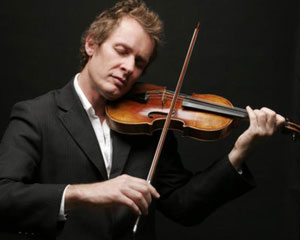
 Left – Richard Tognetti. Photo – Paul Henderson-Kelly
It's apt that the Australian Chamber Orchestra's latest touring proposition is Tognetti's Mozart, for Richard Tognetti and the ACO tend to reclaim and reinvent everything as their very own, by way of distinctive, colourful, characterful and impassioned performance, at the highest standards of virtuosity. It's also emblematic of RT's long reign, as artistic director that, for the ACO's first programme for 2013, it should present works separated in time by a quarter of a millennium, without the slightest justification or apology. It's audacious and admirable. Better yet, it comes off.
For this two-hour concert, Tognetti puts himself and his violin in the hot seat, too. As well as Brett Dean, who conducts his own Electric Preludes, in its Australian premiere. Beginning with Haydn's Symphony No. 49 (in F minor, from the Austrian composer's prodigious catalogue, which includes no less than 106 symphonies alone), the ACO took us on yet another exquisite aural journey. You may well know Haydn's 49th as La Passione, or The Passion; not a nickname endowed by Haydn, but some mildly perspicacious individual along the way who has clearly latched onto its dark depths. It is, after all, from Haydn's so-called sturm und drang period, inspired by an influential literary movement that emanated from Germany in the late 18th century. In many ways, it proved the permission note for classical musicians to step outside the restrictive boundaries of rationalism and pure aesthetics and into more honest and expressive emotional territory. Certainly, on that basis, its tailor-made for Tognetti and team who, from the outset, poured heart and soul into the work. The distinctive and distinguishing fact about Haydn's 'storm and drive' is that, while it may thunder with extreme agitation, it retains the pleasing courtliness (etiquette, if you will) and predetermined shape that epitomises the classical form common to his, Mozart's and Beethoven's music. This seeming anachronism, juggled with such simpatico by the ACO, miraculously emerges as delivering pleasure on both levels: visceral and artistic (for want of a better word). It's an advertisement for the ACO's capacity for sophisticated understanding which, I assume, can only be based on intensive research, vigorous interrogation of the score and a collective intuitive intelligence.
The City Recital Hall's highly favourable acoustics bring the warmth, colour, intimacy and connectedness the ACO brings to any piece right to the fore, so that the first of four movements is capable, I should think, of inducing tears in the susceptible (no confessions forthcoming). Why? Because it is, almost at once, achingly tragic and uncommonly beautiful. It's adagio helps but, essentially, it's Haydn's sense of and feel for tragedy (and the ACO's rendering of it) which seems so deliberately understated, never overwrought or melodramatic; in a way, storm and drive doesn't adequately describe it.
The opening of the allegro di molto second movement is dealt with, by contrast, with the kind of prettiness, delicacy and, dare I say, femininity of which, I fancy, FJH would've heartily approved; a certain lightness of touch. But the powerful, uber-dramatically counterpointed, rhythmic punctuations aren't lost on the orchestra, either: for a chamber orchestra to emulate the dynamics of a full symphony isn't feasible but, thanks again to allowing themselves to be absorbed and stirred by the music they're playing, the members of the ACO lose nothing, really, to a full-scale orchestra. We don't want for more, because they give everything they have. For them, performance isn't merely an intellectual or technical exercise of craft and skill, it's an exposition of what they bring to it, emotionally. This, I believe (after much pondering as to why it stands as arguably the world's best chamber orchestra), is what elevates the ACO above its counterparts. The orchestra and its members have, it seems, unashamedly ardent romantic dispositions which, rather than temper, they choose to exploit, albeit not without ever-present rigour and discipline.
A minuet may be part-and-parcel of the third movement, but this is a stately dance disturbed, interrupted and 'corrupted', once again, by Haydn's proto-Romantic leanings (it may be more allusive than substantive, but it's there, methinks), while the fourth and final presto is as vibrant and exciting as that tempo implies; an almost titillating showcase of the ACO's individual and corporate mastery. The orchestra's experience with this work goes back as far as 1988 and is telling in performance. They've toured it in Europe and America, too; though the last public outing was 2004. Perhaps the interim has been prolonged enough to invigorate them with a renewed hunger for it. Whatever's at play, it works for them and, as a consequence, for us.
'And now for something completely different' would suffice as an apt introduction for the act that followed Haydn: Dean's preludes, which put Tognetti behind the wheel, if you will, of a futuristic, scarlet six-string electric violin which looked for all the world like the instrument George Jetson or Mr Spock might've played, had they shown a more sensitive side. Briswegian (or Brisvegan, if you prefer) composer Dean's pieces have been written specifically for the ACO (commissioned, on its behalf, by visual art curator Jan Minchin) and are both stylistically challenging and cinematically spacious and evocative, referring, as an Australian composer is apt to do, to this wide, brown land, girt by sea; the stark, bleak, lifeless loneliness of abandoned playgrounds; even, apparently, the lyrical intensity of Rilke's poetry, with its Greek mythological motifs.
Perhaps the most notable feature of the Birmingham-made instrument in question is that the two bonus strings are bass (C & F), which almost has it double as a pseudo-cello. The other credit due is to sound engineer Bob Scott, who seems to be 'playing' almost as much as Tognetti, who, I suspect, would be the first to acknowledge, where this particular concerto is concerned, he really couldn't do it without him.
The work itself seems to be very much concerned with exploring and expressing the possibilities (or at least some) of the soloist's instrument so, along with its space age appearance, there's an exploration of the spatial in this highly-textured, assertive, but finely balanced composition. Its other key facet and concern, as Tognetti points out, is with how adventures in electronica might be married to concert hall conventions and traditions. It makes for a fascinating experience and it will be interesting to discover how future familiarity might influence reaction to it. How might the first 'art music' have been perceived, as it emerged from the Christian liturgy? Perhaps a time-travel episode back would not be so different to one going forward.
After a refreshing interval, it was Mozart all the way: firstly, his third violin concerto and then twenty-fifth symphony. As to the former, one might well wonder why Mozart suddenly decided (as he did, early in 1775) to write violin concertos. Well, it turns out he was as proficient (to put it mildly and dryly) on that instrument as on piano. In fact, his typically harshly critical father, Leopold, was quick to encourage Wolfy, crediting his propensity to give his all. Perhaps WAM and RT are musical soulmates, albeit separated by the inconvenience of time, given the wealth of feeling that informs the latter's rendition. Given a somewhat frillier sartorial countenance, one can almost place Tognetti in the court, in Salzburg, all those years ago. There's Mozart, smiling broadly, delighted by the performance. As was I, seeing and hearing how effortlessly and adoringly RT surmounts the work's many technical high-jumps.
The third concerto was a significant one for Mozart. Remember, he was only twenty when he penned it, with two (generally acknowledged as lesser 'warmups') already under his belt. The wonder is he devised such radiant, transcendent, sophisticated pieces of music. Third time lucky? Perhaps only if you're a genius to begin with. And they're not only refined, but sweetly seductive, with out ever being in the slightest twee. Who else, bar Mozart, can strike this balance so magically, without ever falling over the line between cultivation and crassitude? It's a rare thing, but Mozart actually borrows from himself, if only in the sense of charting the convoluted course that characterise and individuate his operas. He interpolates and braids together so many phrases it shouldn't, by rights, succeed. But Mozart, as always, is full of surprises. So, leaving Kansas to wend his way down a yellow brick road of his own paving, he somehow ends up back where he started. It's thrilling as a manuscript, no doubt, but in the playing, it's something else. By the time we get to the third and final movement, a rondeau, the orchestra is in full flight, respecting and revelling in the composer's cleverness. It's as if this work, like Dean's, was written specifically for the ACO; it does it such surpassing justice. Tognetti's cadenzas, in the first movement, are splendiferously sonorous.
Leo Mozart might've had scant regard in his son's symphonic skills, but not only did Wolfy excel, early on, with his twenty-fifth, but he eschewed the traditionally ceremonial context of the form in deference to a minor key. It wasn't unheard of at the time, but it was by no means commonplace. He innovated by orchestrating for two pairs of horns, oboes and bassoons, which certainly lend disturbing textures to this brisk, terse, restless, almost subversive music. But as with virtually all things Mozartian, the result is thrilling. The ACO (augmented by Dean on viola) gives it everything it has. By turns, it thunders and twinkles.
Better yet, the love (I don't think there's any other word for it) the players lavish on this score is there for all to see: Tognetti looking pumped and gleeful in a way Lance Armstrong can't begin to imagine and at another proximal point, it may've been Aiko Goto who was veritably dancing on the spot. And why not? Mozart is nothing if not exuberant. The effect of such obvious enjoyment isn't merely visual entertainment, it enriches and intensifies the qualities of the music. If that's possible.
Australian Chamber Orchestra presents
TOGNETTI’S MOZART
Venue: City Recital Hall, Angel Place
Dates: 12 – 16 February, 2013
Bookings: cityrecitalhall.com