 If you have not attended a Bell Shakespeare production before, or haven’t seen one in a while, this rendition of one of the Bard’s most popular plays is a good example of their bread-and-butter staples of modern popular staging. While the company has had many memorably unconventional approaches to the Shakespearean canon via maverick directors and casting, such as perhaps their forthcoming production of Richard III starring Kate Mulvany in the title role, this rendition of Othello is emblematic of their default approach to the classics. Which is not to damn with faint praise, as Bell Shakespeare’s recent quarter-century anniversary ably demonstrates that their mission to make the works of the great playwright accessible and appealing to young people through modern dress and a focus on robust performances has staying power.
The performances are indeed very much centre-stage here, in a very stripped-back production that employs minimal props and costume changes, a virtually bare set and hardly any staging effects to speak of. The sound and lighting design by Steve Toulmin and Paul Jackson are a little more obtrusive, with occasionally rather distracting flickers and scoring tics, yet at some points providing highly effective shifts in which time appears to slow to a crawl while the villainous Iago makes mid-scene asides to the audience. It is one of several flourishes which serve to showcase the central character whom, as has been observed in countless high school English assignments across the generations, is not really the tragic titular figure, but rather this Machiavellian tormentor.
As much as any production of Othello is doomed to fail without a compelling co-lead in the title part, most will agree that it is Iago which is truly the plum role, a character so deliciously devious in his artful manipulations as to rival the aforementioned Richard III as Shakespeare’s most memorable and complex villain. It is a role many actors dream of tackling, and is often a star vehicle at which noted performers seek to try their hand. Here then, we have in this production an opportunity for one of our less famous yet well-regarded actors to impress, and Yalin Ozucelik most certainly does not disappoint. Not yet as well-known as he deserves to be, Ozucelik has distinguished himself with many roles over the years for Bell and other mainstage companies, generally in supporting parts, and often trending towards the comedic or tragicomic, modes he has mastered with great aplomb. To hear of him cast in such a sinister and major role in the theatrical canon was an exciting prospect, hopefully to see him flex his acting muscles like perhaps never before.
Chameleonic, Ozucelik is at first almost disconcertingly unassuming as Iago, yet his rendition of the role quickly builds into something delightfully unnerving. As one of those characters prone to an especially wide range of performative interpretations, from the overtly mustache-twirling or virtually satanic to attempts at sympathetic psychological credibility, Iago can be somewhat of a cypher for actors trying to explore the zenith of stage villainy. Ozucelik takes an intriguingly nuanced middle route, portraying the villain with both a plausible humanity yet nevertheless an undeniable malevolence at his core. Much like Shakespeare’s own text, this rendition of Iago leans into the many possible explanations for Iago’s behaviour, yet never clearly comes down on the side of either a concrete motivation nor the “motiveless malignancy” oft-cited in those school papers many of us had to write.
With great variations of light and shade, Ozucelik’s sinewy presence as the villain is that of a consummate puppet master, believably turning on the charm of “Honest Iago”, everyone’s confidant and second-best mate, yet turning on a dime to vary his persona as required for each alternating con he seeks to pull. Even when saying nothing, Ozucelik quietly yet inescapably draws focus, his steely eyes keenly observing the actions of others taking place before him, boring into those he hates and seeks to twist to his own ends. And when the action pauses or the stage empties, the mask drops and Iago’s head inexorably swivels to face front, his seething eyes piercing the fourth wall immediately. He excels in filling the role’s many asides and soliloquies with a seductive relish and seeming candour, as though bringing us into his confidence over his evolving plans and improvised schemes. These monologues are electric, but no less so are some of his scenes of deft manipulation as Ozucelik bounces off his cast-mates in truly captivating duologues.
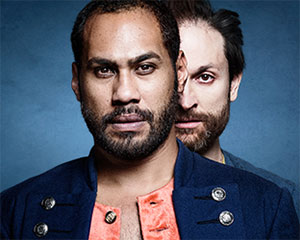
Chief amongst these, of course, is Ray Chong Nee as Othello, the tragic Moorish general and chief victim of Iago’s vindictive machinations. Although undeniably not reaching the heights of his co-star’s wicked performance, Chong Nee has many excellent scenes as the multifaceted and doomed outsider, especially when reacting off Ozucelik in thrilling exchanges as he descends into the jealous insanity of the latter’s design. They form a powerful dramatic double-act, and their interactions are generally the highlights of the play.
At other times Chong Nee is less impressive than one might hope, his performance lacking some of the power and bombast one traditionally associates with the role, with some of his acting choices veering into the inscrutably internalised at the outset, and verging on the incoherently hysterical towards the conclusion. It is for the most part a strong performance, however, which perhaps would have benefitted from some tighter directorial guidance.
Indeed, Peter Evans’ direction does seem to be the likely culprit for this generally solid production’s occasional failings, such as occasionally rather uninspired staging, particularly in the scenically interesting yet dramatically unsatisfying final scene. While the tight dialogue sequences are usually excellent, and Cassio’s drunken revel is impressively realised as a kind of rave scene which culminates in an unexpected technical coup de théâtre whereby time slowing to a crawl is represented by an inflated wine cask magically floating like a slow-motion balloon, many other key episodes are not so well handled.
Moments in the climax typically seared into your brain with their awful revelations and reversals of fortune seem awkward and lacking in punch, such as Desdemona’s murder, or particularly the final confrontation between Iago and his wife Emilia, as rather flatly played by Joanna Downing. It is hard to know whether to lay the blame at Downing’s feet or Evans’, for even the elsewhere magnificent Ozucelik can’t seem to salvage the requisite dramatic weight of Emilia revealing her husband’s perfidy, such that his subsequent abrupt murder of her before scarpering offstage even appears unintentionally comedic.
Also of note are Elizabeth Nabben and Michael Wahr as very solid renditions of Desdemona and Cassio, and Edmund Lembke-Hogan as possibly the best Roderigo I’ve ever seen in dozens of productions. The thankless role of Iago’s hapless stooge is rendered highly memorable here by Lembke-Hogan’s understatedly funny performance.
Were it on the basis of the production concept or supporting cast alone, I would say that this is an eminently respectable production, but one that might be, ultimately, skippable. Ozucelik, however, is so exceptionally good in his nuanced, mercurial performance as Iago, whether sparking off Chong Nee, Wahr and Lembke-Hogan or when holding the audience in the palm of his hand solo, it is a rendition of the Bard’s immortal antagonist which is, I dare say, a must-see.
Bell Shakespeare presents
Othello
by William Shakespeare
Director Peter Evans
Venue: Playhouse | Sydney Opera House
Dates: 25 October – 4 December 2016
Bookings: www.sydneyoperahouse.com